

Marine Casualties come in all shapes and sizes. I have been intrigued for many years of the ‘why’ did that happen and how can we prevent it.

This page is to share information with the Mariners of the world to make each vessel a safer work environment. I have listed the website for the National Transportation Safety Board and the United Kingdom’s Maritime board, both listed below:
https://www.ntsb.gov/investigations/AccidentReports/Pages/Reports.aspx?mode=Marine
These are two great sources of mostly unbiased information from the investigations. I will be drawing from their published reports and other sources to glean useful guidance for my fellow mariner.
VESSEL INDEX
One - M.T. STENA IMMACULATE and M.V. SOLONG
Two - M.T. KEOYOUNG SUN
Three - M.V. LADY MARY JOY THREE
Four - M.V. XING SHUN NO. 1
Five - Fishing Vessel TREMONT
Six - Tug CAPT. KIRBY DUPUIS
INCIDENT - DATELINE - MARCH 10, 2025
M.T. STENA IMMACULATE AND M.V. SOLONG
1-M.T. STENA IMMACULATE
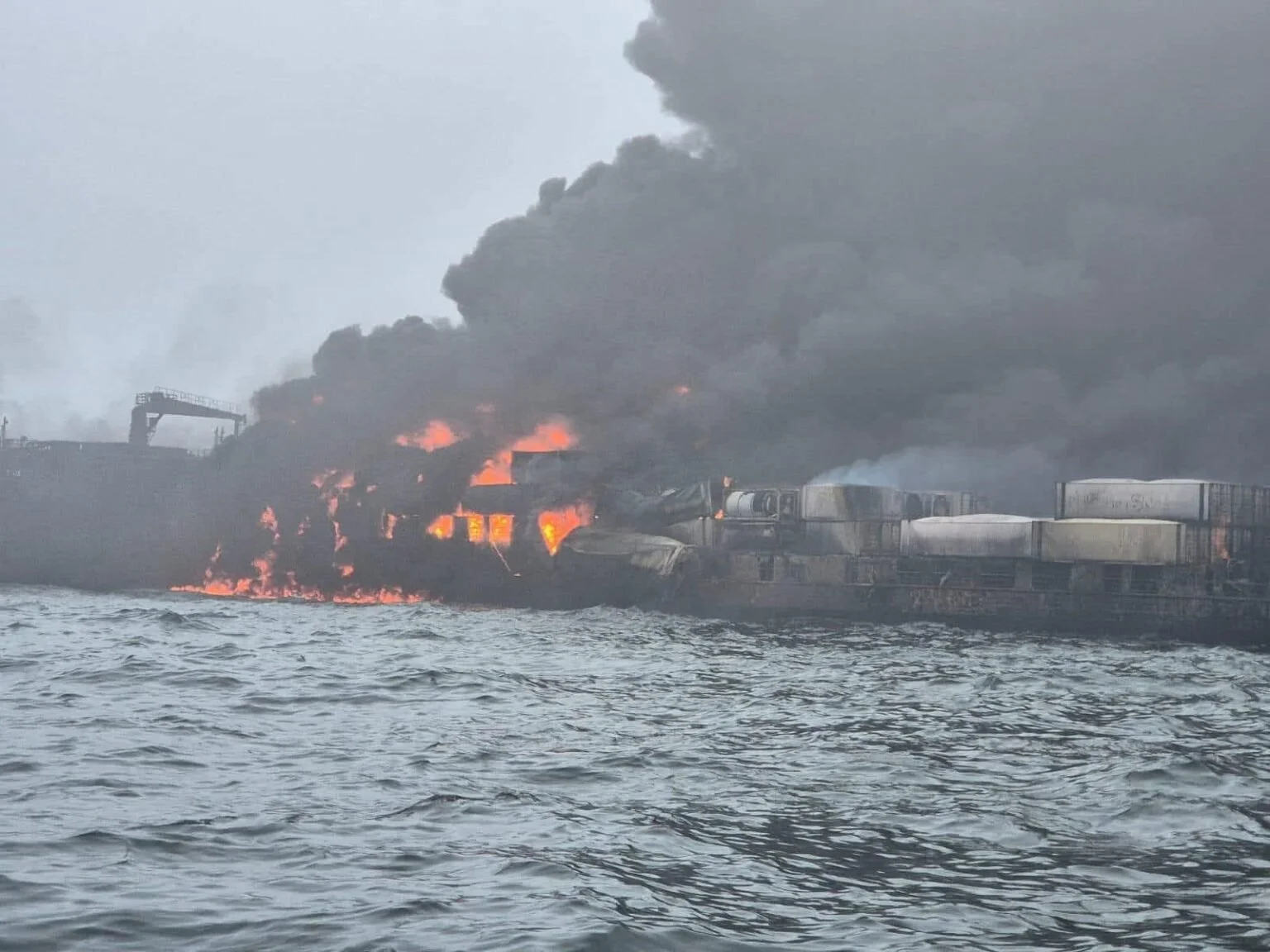
The unfortunate result of a Coastal Trading Container vessel and an Anchored Tanker carrying Aviation fuel.
Photo courtesy of Social Media.
(Last updated August 16, 2026)
We have pulled the below details from the MAIB Interim Report of April 2025.
“BACKGROUND
On 27 February 2025, the USA registered oil/chemical tanker Stena Immaculate (Figure 1) departed Agioi Theodoroi, Greece with a cargo of 220,204.5 barrels1 of aviation fuel on board. The tanker was bound for Killingholme, England, and was expected to berth on 11 March 2025.
The Portugal registered containership Solong (Figure 2) was engaged in fixed trade in the North Sea, sailing between Rotterdam, Grangemouth and Hull. On 10 March 2025, its containerised cargo included various products including some designated as dangerous goods.”
(Two vessels just sailing along on schedule.)
“ACTUAL INFORMATION
As Stena Immaculate approached the Humber Estuary on 9 March 2025, the officer of the watch contacted Associate British Ports (ABP) Vessel Traffic Services Humber and was advised to proceed to anchor at a position 5 miles to the north of the Humber light float and 2 miles clear of any pipeline. At about 18302, Stena Immaculate’s master manoeuvred the vessel as directed to a position north of ABP Humber’s area of responsibility where it anchored. There were eight other vessels anchored in the same area.
By 2000 on 9 March 2025, Solong had departed Grangemouth, Scotland, disembarked the pilot and commenced its passage to Rotterdam, the Netherlands. Solong’s planned passage followed a route the vessel had used in the past. The master remained on watch until shortly before 2300, then handed the watch over to the second officer (2/O) and retired to bed.
Shortly before midnight, Stena Immaculate’s 2/O took over the anchor watch at the start of a 12-hour duty period.
At approximately 0130 on 10 March 2025, Solong passed the Longstone Lighthouse off the north-east coast of England and altered course onto a heading of approximately 150°. Solong maintained this course except for a slight deviation at 0345.
At 0700, Solong’s master returned to the bridge and took over the watch as the lone watchkeeper.
The visibility in the area north of the Humber light float was reported to be patchy and varying between 0.25 nautical miles (nm) and 2.0nm. Neither Solong nor Stena Immaculate had a dedicated lookout on the bridge.
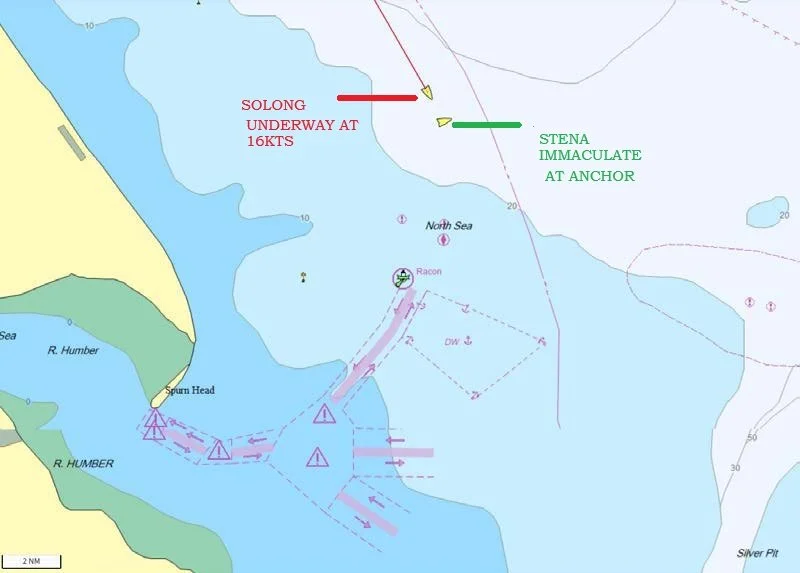
At 0947, Solong collided with the anchored Stena Immaculate’s port side on a heading (HDG) of 150° and speed over the ground (SOG) of about 16 knots (kts) (Figure 3). Able seaman Mark Pernia, one of Solong’s crew, was reported to be in the forecastle area at the time of the collision.”
This looks like the M.V. SOLONG was following along the 20 fathom line on the chart. This is a common practise so as not to run aground. This appears to be the intended trackline, so why route it that close to a known anchorage area??
Was the Master utilizing his collision avoidance /Radar systems to determine any vessel traffic that might be along his route? Did he look out the bridge viewing areas or go out to the wing of the bridge? Or was he working on paperwork? All good questions that should be answered with MAIB and the US Coast Guard.
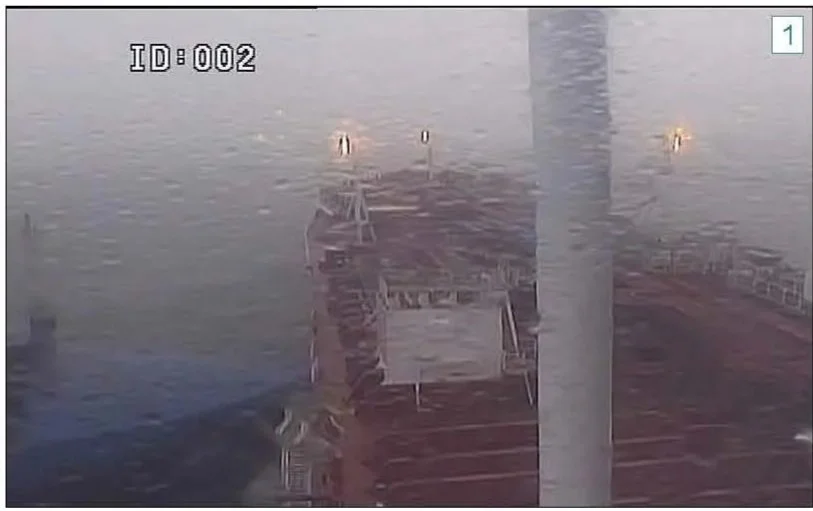
Below is a horrific photo from the MAIB showing the bow of the M.V. SOLONG preparing to puncture the hull of the M.T. STENA IMMACULATE at the No. 7 Portside Tank, which was loaded with thousands of gallons of Aviation Fuel. The force of the M.V. SOLONG travelling at 16.0 knots supplied the ignition source for the ensuing catastropic fire aboard both vessels. Wow!
INCIDENT - DATELINE - MARCH 20, 2024
M.T. KEOYOUNG SUN - (Update February 20, 2026)
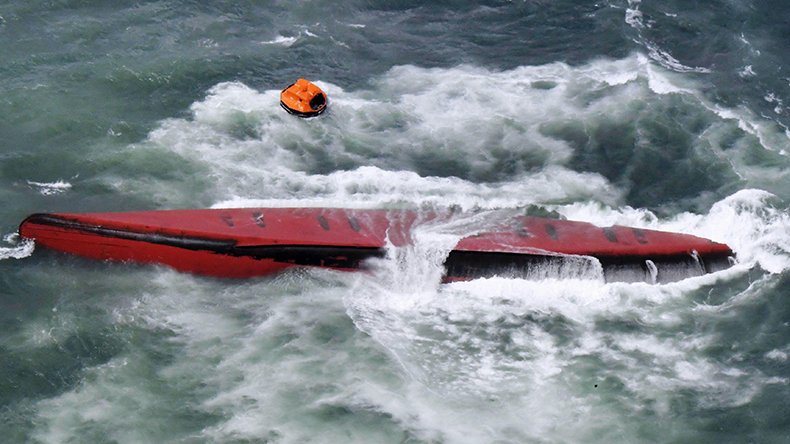
Unfortunate Chemical Tanker M.T. KEOYOUNG SUN experiencing negative GM off Mutsure Island, Japan.
Photo courtesy of Newscom/Alamy Stock.
(Last updated February 20, 2026)

Description - Aerial view of Mutsure Island
日本語: 馬島(左)と六連島(右)
Date October 2021
Source Own work
Author ブルーノ・プラス

The Meteorological Agency had sent out a storm and high wave warning for Yamaguchi Prefecture on March 20, 2024.
We do not have any indication at this time of what actually happened to the very unfortunate vessel. Please check back with our next update.
February 20, 2026 - UPDATE FROM KOREA MARITIME SAFETY TRIBUNAL
We have an Executive Summary from the Marine Safety Investigation Report [MSI Report 2024-007] as follows:
1.1 Keoyoung Sun was an oil and chemical tanker (hereinafter referred to as "the tanker") built at the shipyard of Sasaki Shipbuilding Co., Ltd. in Japan and registered at Jeju Port in Korea. She had a gross tonnage of 597 tons, or 870 GT ITC, a registered length of 64.01 meters, a breadth of 10.60 meters, and a depth of 4.60 meters, and she was equipped with one 1,176-kilowatt diesel engine.
1.2 The tanker arrived at Himeji Port at around 11:00 on 17 March 2024. At around 09:45 on 18 March, the next day, she commenced the loading of cargo, acrylic acid1) and then departed laden with 978 tons of cargo at around 14:30 on that day. Her drafts forward and aft on departure were 3.85 meters and 4.45 meters, respectively.
1.3 The tanker was originally scheduled to enter Taixing Port in China. However, as her ballast water was not discharged during cargo loading at Himeji Port, the port of destination was changed to Busan to repair her ballast pump. The estimated time of arrival (ETA) at Busan Port was to be around 23:00 on 19 March 2024.
1.4 Keoyoung Sun passed through the Kanmon Straits At around 12:00 on 19 March, At around 17:00 on the same day, the master reported to the company that the weather was not in a fair condition and the hull was listing toward port. At around 20:00, the master again reported to the company that the weather was further worsening and the tanker speed declined to three or four knots, hampering the tanker’s operation, and thus the tanker would anchor at the waters adjacent to the Kanmon Straits.
1.5 At around 20:00 on 19 March, the tanker sailed to the waters about 7 nm northwest of Shimonoseki in Japan for sheltering, and at around 02:05 on the next day, the tanker paid out six shackles of her starboard anchor chain and lay at a single anchor. The anchored position was 34° 03′31″N, 130° 50′ 11″E.
1.6 While anchoring, the heavy weather conditions caused the tanker's hull to experience anchor dragging. At around 06:00 on 20 March 2024, the master informed the company that the hull was listing toward port. Later, at around 07:00, he reported that the tanker's crew needed to be rescued as the hull listed to port significantly. The listing to port continued, and the tanker capsized about 3.5 nm southeast of Futaoi Island, in Japan (34° 03′11″N, 130° 50′58″E) at around 07:53 on 20 March 2024.
1.7 Since the tanker's hull was overturned amid the heavy weather conditions, the crew failed to board lifeboats and jumped into the waters only wearing life jackets. At around 08:15 on 20 March, about 22 minutes after capsizing, the Japan Coast Guard (JCG) initiated rescue operations. However, only one person, the 1/E, survived out of the total 11 crewmembers and the other ten persons, including the master and the C/E, died. The capsized hull was recovered but declared a total loss due to its damage from the capsizing.
Marine Safety Investigation Report
on Oil/Chemical Tanker Keoyoung Sun
- Capsizing -
Date of Accident: 20 March 2024
Date of Publication: 27 December 2024
Korea Maritime
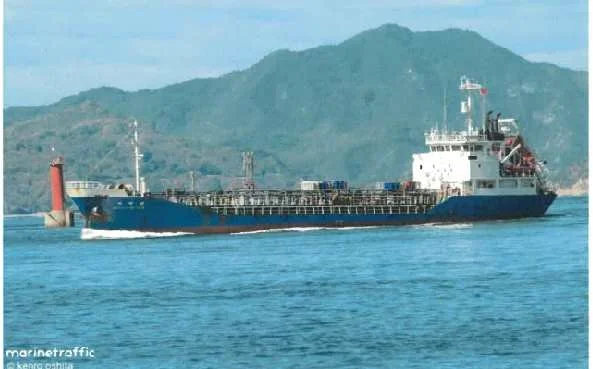
We have a photo from Marine Traffic of the M.V. KEOYOUNG SUN on a typical sunny day with positive GM. This is a tragic story that has several players involved.
The analysis continues with the Korean Maritime Tribunal worked their way through the possible outcomes for the tanker based on the reports that the Master had sent to the shoreside managers. These are listed below:
4.1.3 Case No. 1 calculated the tanker's stability, using conditions set by the cargo tank loads written in the cargo stowage plan: the displacement was about 1,900 tons; the resulting draft was about 3.861 meters, not exceeding the load line of 3.892 meters; and heeling to both sides was not significant. Thus, the tanker satisfied all of the IMO criteria, meaning that she maintained intact stability.
4.1.4 Case No. 2 decided the displacement based on the draft written in the cargo stowage plan and added the unknown constant of 137.9 tons to WBT No. 1 (P/S) and WBT No. 2, which increased the displacement above that of Case No. 1. As a result, the draft became 4.115 meters, which means the tanker was overloaded, exceeding the load line. Still, she satisfied all of the IMO criteria with no intact stability issues.
4.1.5 Case No. 3 divided the unknown constant of 137.9 tons into WBTs No. 1 (P/S), No. 2 (C), No. 5 (P/S), No. 6 (C), and No. 7 (C) based on the phone conversation made between the master and the company prior to departure. Moreover, its GM values decreased relatively more than that of Case No. 2 due to the free surface effect of WBTs, leaving the tanker unstable without satisfying the IMO criteria, while the stability calculations violated the IMO criteria.
4.1.6 Case No. 4 assumed that the hull's heeling would have moved the tanker's ballast water as much as possible from the condition of Case No. 3, and as in Case No. 3, the tanker was unstable as she failed to satisfy the IMO criteria. In particular, as the ballast water shifted, the heeling angle was calculated at up to about 19 degrees, which means that the tanker was assumed to have risk of capsizing.
4.1.7 Case No. 5 calculated factors based on the tank loads in the Japanese salvage and rescue agency's report: the tanker was overloaded, exceeding the load line, due to increasing ballast water loads; and she remained unstable as she did not meet the IMO criteria. In this case, the tanker's deck presumably could have been flooded as she heeled to the port side by seven degrees.
4.1.8. Case No. 6 assumed that the tanker's ballast water would have moved to the maximum from the condition of Case No. 5, which means the tanker was unstable without meeting the IMO criteria. In particular, Case No. 6 calculated that the tanker may have heeled up to about 70 degrees depending on the ballast water movement. Thus, the tanker was assumed to capsize. 4.1.9. As the tanker's stability was analyzed and calculated based on the six presumable cases above, it was identified that the tanker failed to meet the IMO criteria and had stability issues in Case Nos. 3 through 6, which were presumed to describe the tanker's condition upon departure.
4.1.10. The static stability calculations showed that the tanker could have heeled up to about 70 degrees due to the heeling caused by ballast water movement and the free surface effect of the cargo tanks.
Marine Safety Investigation Report
on Oil/Chemical Tanker Keoyoung Sun
- Capsizing -
Date of Accident: 20 March 2024
Date of Publication: 27 December 2024
Korea Maritime
Alright, how many of my fellow mariners have worked on a vessel that actually heeled over 70 degrees while out on one of the seven seas (maybe some wind sailors)? That’s right, none of us. 70 degrees is when you have your survival suit on and are jumping into the water. Which, unfortunately for this crew, no one had on anything better than a lifejacket.
We pickup at the conclusion section of the MSI Report 2024-007 as they list six parts to their findings:
Conclusions
5.1 In this report, it was assumed that ballast water had remained in the tank of Keoyoung Sun since departure and commissioned simulations so that the tanker's static stability could be calculated for six possible scenarios with the adjusted amount of ballast water and tank arrangements. The results showed that the tanker could have heeled as much as 70 degrees from the free surface effect resulting from the ballast water movement and that of cargo within the half-loaded tank.
5.2 The analysis on the tanker's dynamic motions which simulated the situation at the time of the accident
showed that the tanker's rolling would have been significantly amplified due to the interaction between the waves and wind on the starboard side, decreasing the hull stability and increasing the capsizing risk. Notably, the cyclical effect of the wind and waves further extended the rolling period, which presumably impacted the tanker's stability severely. In the capsizing simulation, the deck was flooded with seawater, confirming the risk of capsizing.
5.3 The cargo stowage plan written according to the company's Instructions showed no ballast water remaining in the tanker's WBTs. However, the displacement calculated based on the drafts differed from that in the cargo stowage plan, suggesting the tanker's cargo stowage plan failed to reflect the exact loaded condition of the tanker.
5.4 Keoyoung Sun's load line was 3.892 meters, while the departure draft was 4.150 meters, which means the tanker was overloaded, increasing her draft about 0.26 meters above the load line, when she set sail. The tanker wrote the exceeded drafts in the departure report and reported it to the company. However, the company failed to check it, and thus, measures needed to resolve overloads were not taken.
5.5 The tanker was at anchor in waters about 30 meters deep, which is recommended for a ship with a gross tonnage of 30,000 tons or more. It was too deep for this tanker to anchor there. In heavy weather the tanker was obliged to select a safe anchorage by considering the water depth of the location and the length of her anchor chain, but failed to do so.
5.6 Keoyoung Sun did not take safety measures even as she dragged anchor and listed in heavy weather. Those measures included using the main engines to resolve the anchor dragging and securing the holding power by dropping the port-side anchor or mooring with two anchors.
The conclusion section of the MSI Report 2024-007 is fairly potent. They calculated for six different scenarios, with two ok, and the other four were deadly. They have the tanker as a possible 70 degrees of heeling, which would have flooded the deck and further reduced the already reduced stability. I think that section 5.4 in the middle sentence, “The tanker wrote the exceeded drafts in the departure report and reported it to the company.” Wow!! Why did no one recognize that the vessel was overloaded and heading into very rough weather with an inoperable ballast pump. Do you think the cook knew these facts?
The Korean Maritime Tribunal in their report, MSI Report 2024-007 , gave out four recommendations and have listed the second recommendation below:
The company must check if the tanker's drafts written in the departure report exceed the load line instead of simply receiving the departure report as a mere formality while strictly managing its fleet so that no ship departs with her drafts above the load line.
That is a great reminder to all who work with vessels that ply the dangerous ocean waters that we all make our living from. Why would they allow a tanker to sail in an overloaded condition? Drop me a line if you have a comment - captain@clauhsmaritime.com
Keep Safe!
M.T. KEOYOUNG SUN view from another angle off of the Mutsure Island, Shimonoseki, Yamaguchi Prefecture, Japan. Courtesy of KYODO, AFP-JIJI, JIJI.
The Japan Times, on March 21, 2024, reported the following: “Eight crew members perished after a South Korean chemical tanker capsized off the western Japanese city of Shimonoseki, Yamaguchi Prefecture, on Wednesday, a local coast guard office has said.
The coast guard said Thursday that it has rescued one of the two other crew members who were missing, but did not state that person's condition.
The 870-ton Keoyoung Sun's crew radioed for help at around 7:05 a.m., reporting that the ship anchored near Mutsure Island off Shimonoseki was capsizing, according to the Moji Coast Guard Office near the area.
On board the tanker at the time of the incident were 11 crew members — eight Indonesian nationals, two South Koreans and one Chinese. The eight confirmed dead were among nine initially rescued, with the remaining survivor having no life-threatening injuries. The search continued on Thursday to find one other missing crew member.
All nine rescued were wearing life jackets, according to the coast guard office.
The vessel was carrying 980 tons of acrylic acid, although no leaks have been confirmed, the coast guard office said.”
The tanker’s voyage plan had the vessel departing a port in Himeji, Hyogo Prefecture, Japan for the port of Ulsan, Korea. The vessel apparently had been anchored off of the island of Mutsure in the Sea of Japan.
INCIDENT - DATELINE - MARCH 30, 2023
M.V. LADY MARY JOY THREE

Philippine Coast Guard vessel spraying down M.V. LADY MARY JOY 3 offshore of Basilan.
Photo courtesy of Philippine Coast Guard/AP.

(Last updated November 01, 2023)
M.V. LADY MARY JOY 3 beached on Island of Basilan. Photo courtesy of Philippine Coast Guard/MarineLink.
We have a dispatch from the MarineLink with the following: “Philippine rescuers searched the smoldering ruins of a burnt-out ferry on Thursday for any survivors or more victims of a fire that swept through the inter-island vessel killing 29 people, including a 6-month-old baby, authorities said.
Investigators have yet to identify the cause of the fire that started at about 11 p.m. (1500 GMT) on Wednesday off the southern island of Basilan, when many passengers were asleep in air-conditioned cabins on the ferry's lower deck.”
Ferry boats can be notorious for packing in the poor below deck. This does not appear to be the case in this tragedy. The Philippine Coast Guard reported that the vessel was not overloaded and that a total of 225 people had been rescued from the event, including 36 crew.
We will await the incident report for the genesis of the fire.
UPDATE - NOVEMBER 01, 2023 - “BASILAN, Philippines – The Bureau of Fire Protection (BFP) on Monday, April 3, said faulty electrical wirings could have caused the March 29 fire that engulfed the ill-fated passenger ferry MV Lady Mary Joy 3 off an island in Basilan.
Based on the final count of the Basilan provincial government, 28 ferry passengers were either found dead in the waters off the island or burned in the vessel, and two Army soldiers, identified as Staff Sergeant Andrew Cerbatos and Private 1st class Marion Malda, have remained missing.
BFP-Basilan chief Senior Superintendent Kadil Acalul on Monday, April 3, announced the result of the investigation by BFP investigators from Manila who went to Basilan to check the ill-fated vessel now grounded at Baluk-Baluk Island in Hadji Mutamad town. Acalul said the team of investigators’ findings indicated that the fire was “electrical in nature,” and likely caused by a short circuit.” Report and photo from Richard Falcatan on Rappler.com
Below - Investigation team from the Bureau of Fire Protection -Basilan boarding the vessel to conduct initial assessment of the causes of the fire that engulfed the M.V. LADY MARY JOY 3 off of Basilan.

INCIDENT - DATELINE - OCTOBER 29, 2022
M.V. XING SHUN NO.1

(Last updated November 03, 2022)
M.V. XING SHUN NO.1 off the island of Taiwan. Photo courtesy of Taiwan Coast Guard.
Five crewmembers rescued from sinking of the M.V. XING SHUN NO.1 off the coast of Taiwan. Twelve crewmembers still missing from the vessel. Taiwan Coast Guard searching the area for survivors.
INCIDENT - DATELINE - OCTOBER 28, 2022
FISHING VESSEL TREMONT

(Last updated November 02, 2022)
USCG footage of the Fishing Vessel Tremont on October 28, 2022, after being struck by a container vessel 63 miles southeast of Chincoteague, Virginia. Photo courtesy of Coast Guard Air Station Elizabeth City.

USCG vessel delivering the crew from the sunk Fishing Vessel Tremont on October 28, 2022, to the USCG base at Chincoteague, Virginia. Photo courtesy of US Coast Guard/ PO1 Jonathan Lally.
INCIDENT - DATELINE - November 09, 2021
TUG CAPT. KIRBY DUPUIS
VESSEL CAPT. KIRBY DUPUIS
TYPE TOWING/BARGE (TOWING VESSEL)
FLAG UNITED STATES OF AMERICA
PORT NEW ORLEANS, LOUISIANA
YEAR BUILT 2011
OFFICIAL NO. 1229999
IMO NO. N/A
CLASS N/A
LOA 120 FT (36.6 M)
BEAM 35 FT (10.7 M)
DRAFT 11.6 FT (3.5 M)
TONNAGE 436 GRT
ENGINE 2 X 2,000 HP (1,491 KW) CATERPILLAR
3512 C DIESEL ENGINES
“On November 9, 2021, about 0708 local time, a fire broke out on the port main diesel engine on board the towing vessel Capt. Kirby Dupuis. The vessel was pushing thirteen loaded dry cargo barges while transiting upbound on the Ohio River at mile marker 501 near Belleview, Kentucky, with a crew of six. Crewmembers fought the fire using portable extinguishers and attempted to use the vessel’s fixed fire-extinguishing system. The fire was extinguished by local firefighters in the early afternoon, and the vessel was towed to port. No pollution or injuries were reported. Damage to the vessel was estimated at $1,800,000.” This is the opening statement from the National Transportation Safety Board (NTSB) report MIR-22/24.
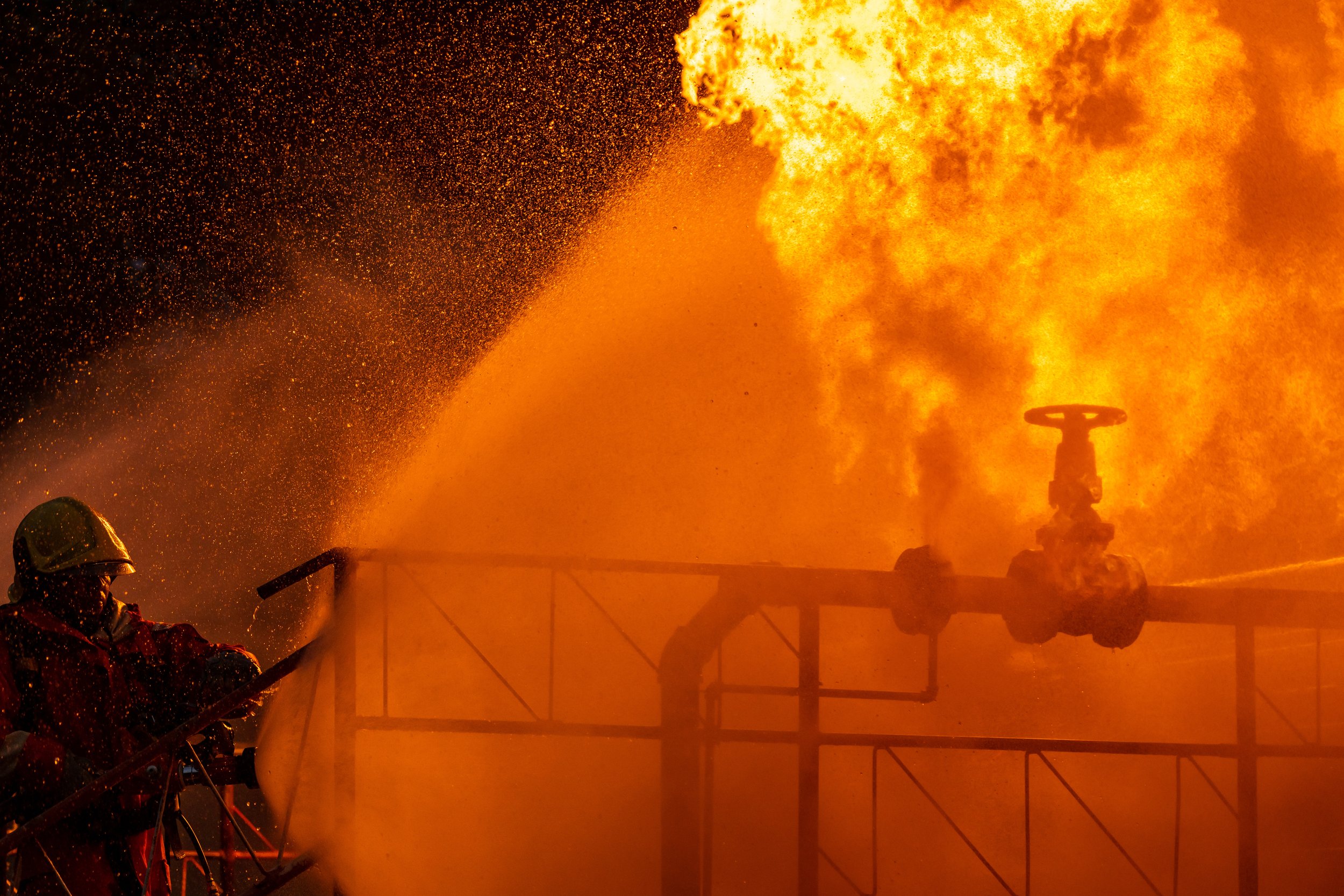
The fire was declared out at 1300 hours, that means for almost six hours the engine room was on fire. That was a dangerous situation and the fact that no crewmember was injured is truly amazing. Fire on a petroleum fueled vessel is about the scariest thing that you can imagine in the Maritime field.
The NTSB report continues, “On the morning of November 9, the towboat was transiting with both engines about 1,275-1,290 rpm (typical underway engine loading) for a speed of about 5–6 knots. About 0708, the captain, on watch in the wheelhouse, noticed a flash on the engine room video display. Immediately following the flash, the vessel’s fire detection system alarmed. The captain sounded the general alarm and instructed the deckhand on watch to notify all crewmembers about the fire and to begin firefighting efforts.
About the same time, the deckineer, in the engineer’s office on the main deck overlooking the engine room, saw a fire near the port main engine in the lower engine room. He retrieved a fire extinguisher and attempted to enter the upper engine room from the main deck passageway, but the smoke and heat prevented him from accessing the space. He then joined the other crewmembers to try to fight the fire from the starboard-side exterior main deck. The deckineer tried to start the fire pump from a remote pushbutton on the exterior bulkhead, but it was inoperable (he looked through a window into the engine room and believed the electrical switchboard for the fire pump was “melting”). Unable to enter the engine room and without an operable fire pump, the deckineer contacted the captain via handheld radio and requested permission to activate the fixed fire-extinguishing (suppression) system for the engine room.”
Fighting an active fire on a vessel requires good decision making and a knowledgeable team working together. When a team member acts out of fear, he forgets his training, acting out of knowledge enables them to perform their task as needed. This is one reason WHY you should always make your fire fighting and emergency scenarios as realistic as possible.
Back to the NTSB report, “To prepare for the release, the deckineer and crewmembers closed the engine room doors, windows, and ventilation dampers on the stacks. The deckineer activated the remote emergency fuel shut offs for the engines (located on the exterior bulkhead). After securing the engine room, the deckineer returned to the main passageway by his stateroom and “hit the first fire suppression system” by pulling one of the two remote pull levers.
He observed the portside fire diminishing but then saw flames growing on the starboard side of the engine room near a stack of boxes filled with oil filters. He told investigators that he believed the fire had traveled across the engine room from the port main engine to these boxes because the port ventilation supply fan, which discharged directly above the port main engine, remained on during the initial stages of the fire. (The ventilation supply fan shut down at an unknown time during the casualty; the deckineer attributed the shutdown to fire damage to the fan’s switchboard.)”
This is a good example of why all ventilation should be shut down during a major fire incident. The intrusion of fresh air into an open flame is the third leg of the fire triad (Fuel/Ignition/Oxygen). Remote shut offs should be used and checked during your normal fire drills. The more you can simulate real world issues in a drill, the more likely that your fellow mariner will know what switch to throw in an Emergency.
They eventually got the fire under control, but only with outside assistance. From the NTSB report, “Several nearby towing vessels arrived to assist with firefighting efforts, exterior boundary cooling, controlling the Capt. Kirby Dupuis’ tow, and evacuating crewmembers. A fireboat arrived on scene at 0858, and the fire was extinguished about 1300 with the assistance of multiple fire departments. The fire caused extensive heat and smoke damage to the vessel’s engine room. The upper and lower engine room bulkheads and overheads were completely burned by the fire as well as the machinery, fixtures, and equipment in the upper engine room. A marine surveyor estimated the damages to be 1.8 million dollars.”
The next day a ‘hotwash – after action investigation’ was conducted by United States Coast Guard and the NTSB members. From the report, “…investigators reviewed the vessel’s video system. At 0708:50, lube oil began to spray inboard from the port main engine into the center of the engine room toward the starboard main engine. About 10 seconds later, a flame at the top of the forward part of the engine by the exhaust manifold erupted inboard toward the starboard engine. The video lasted about 1 minute, until the camera stopped recording.” The video systems are really helping out in the earlier discovery of fire onboard vessels. This is a component that I would recommend if you are in the process of overhauling your engine room.
A technical service manager then inspected the engine and reviewed the above described video footage. He concluded in his report to NTSB that, “the cause of the fire was “a severe oil leak” that sprayed onto the exhaust manifold of the port main engine near the no. 1 cylinder and ignited. “Ventilating air from the air duct above the [port main] engine supplied the fire with oxygen and blew the fire across the engine room damaging the stbd. [starboard] main engine.”
The report gives the following conclusions for this incident on the towing vessel, “The National Transportation Safety Board determines that the probable cause of the engine room fire aboard the towing vessel Capt. Kirby Dupuis was a lube oil tube on the port main engine that vibrated out of a joint due to a missing retaining ring and mounting bracket, spraying pressurized oil that made contact with a hot exhaust surface and ignited. Contributing to the severity of the fire damage was the crew’s unfamiliarity with activation procedures for the fixed fire-extinguishing system, which resulted in an unsuccessful attempt to release the fire suppression fluid and extinguish the fire.”
Drills are necessary for all persons onboard to gain familiarity with the various types of equipment that one would encounter on that type of vessel. A small engine room on a Towing Vessel can be claustrophobic during normal operating conditions, imagine now that one side of the engine room is ablaze. What should you do? That is where your training for that type of situation should kick in.
Last two sentences from the NTSB report, “Crewmembers should train for engine room fires and review extinguishing system instructions. Training drills should ensure that crewmembers are familiar with fixed fire-extinguishing systems and procedures, including confirming crew evacuation, isolating the protected space, and activating the system.”
Again, good, realistic emergency drills at all times will only enhance the cohesiveness of your existing crew and bond them into a fire fighting unit that you can depend on when you need it.
(Last update November 01, 2022)


Who says lube oil doesn’t burn? The lubricating oil was atomized by the leak in the O ring and ejected into the atmosphere of the Engine Room. One second of time between the middle frame and bottom frame. That’s it, one second later and you have a major fire in your Engine Room.